16/03/2026
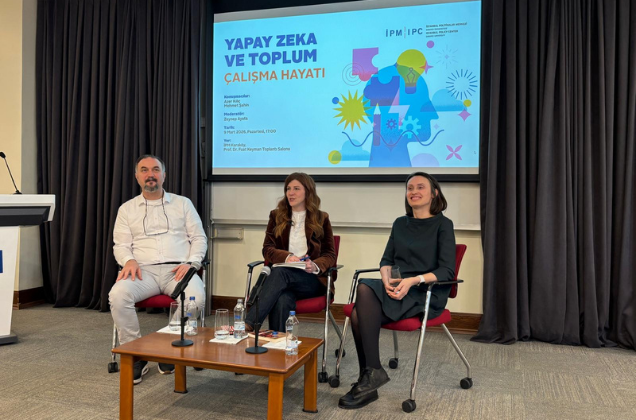
The second meeting of the “Artificial Intelligence and Society” talks series, moderated by Zeynep Ayata and addressing the social impacts of artificial intelligence from various perspectives, was held on Monday, March 9, 2026, under the title “Working Life.” The event, held in the Prof. Dr. Fuat Keyman Meeting Hall at IPC Karaköy, featured Azer Kılıç and Mehmet Şahin as speakers.
In her opening remarks, Ayata emphasized that the aim of the seminar series is to address artificial intelligence not merely as a technical development, but within the context of a broader social transformation that is changing institutions, working methods, and daily life. In this context, the event discussed the effects of artificial intelligence technologies on the labor market, the transformation of professions, and how automation is reshaping working life.
Artificial Intelligence and the Transformation of Labor
The first speaker of the session, Mehmet Şahin, addressed the relationship between artificial intelligence and labor, particularly through the development of machine translation technologies. Şahin, who presented the historical development of machine translation from the 1950s to the present, stated that the transformation from statistical methods to neural machine translation models has significantly changed translation practices.
Noting that this transformation has also redefined the role of translators, Şahin said that today, translators are increasingly involved in the post-editing processes of texts generated by artificial intelligence. The presentation also addressed the effects of automation on labor processes, productivity debates, and different theoretical approaches to working hours in the age of artificial intelligence.
Automation Debates and the Future of Professions
The second speaker of the event, Azer Kılıç, evaluated the debates on artificial intelligence and automation from the perspective of the future of professions. Stating that the question of "which professions will disappear?", which is frequently raised with technological transformation, has gained widespread attention in the public, Kılıç noted that some studies show translation as one of the professions most likely to be affected by artificial intelligence.
Kılıç also shared the findings of a survey conducted with translators in Türkiye, stating that participants approached artificial intelligence technologies not only as a threat but also as a development creating new ways of working and opportunities. She emphasized that this shows that technological transformation should be evaluated not only through technical advancements but also through the experiences of employees and organizational contexts.
Working Life in the Age of Artificial Intelligence
Throughout the discussion, it was stated that artificial intelligence is transforming not only specific professions but also ways of doing business; automation, data-driven decision-making mechanisms, and digital tools are reshaping work practices in different fields. This transformation necessitates a rethinking of issues such as productivity, creativity, and the role of human labor.
The "Artificial Intelligence and Society" talks series, planned to be held monthly, will continue to cover the societal impacts of artificial intelligence through different themes in upcoming events. The series aims to address the relationships between technology, ethics, economics, and society from an interdisciplinary perspective.